PTSD Resolution - News article
ID: 250626
PTSD Resolution Named as Finalist For The Soldiering On Awards 2026
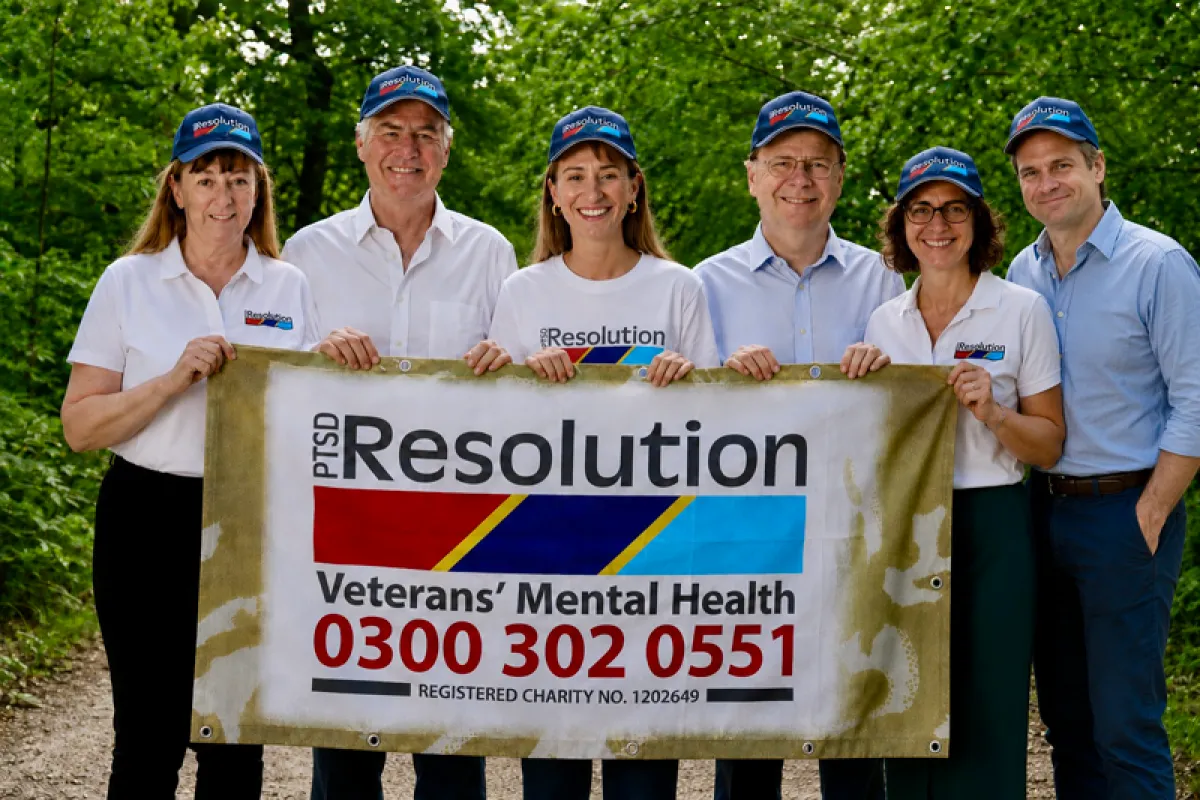
PTSD Resolution, the national charity providing specialist trauma therapy for veterans, reservists and their families, has been named as a finalist for the Soldiering On Awards 2026 in the Health Care and Rehabilitation Award category.
Founded in 2009, the charity has treated more than 5,000 veterans, reservists and family members through free, confidential, one-to-one therapy, delivered online and face to face through a UK-wide network of more than 200 specially trained therapists.
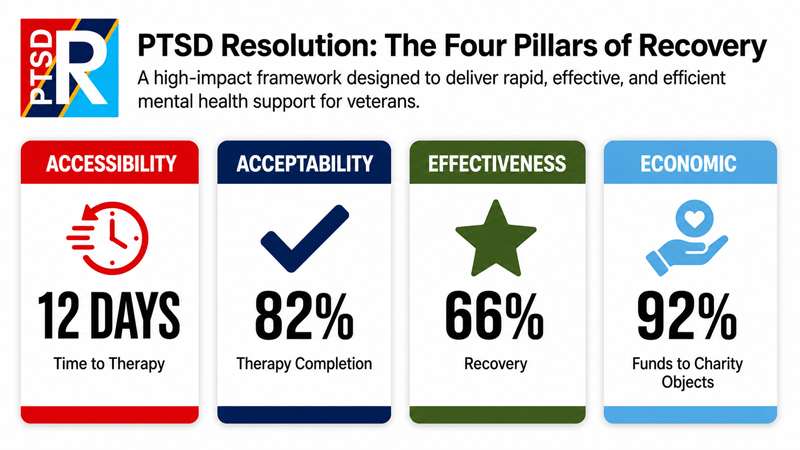
The nomination recognises the charity's development and implementation of the Four Pillars Framework for Recovery, the system that has driven an increase in client referrals from 388 in 2024/25 to 633 in 2025/26, a 63 per cent rise. That growth is not the result of a single good year. It reflects sixteen years of building a service that people in crisis can actually reach, actually stay with, and actually recover through. Momentum is continuing into 2026/27, with online self-referral now fully integrated into the charity's case management system, enabling round-the-clock access and end-to-end tracking from first contact to first appointment, currently averaging 12 to 13 days.
The Four Pillars Framework for Recovery
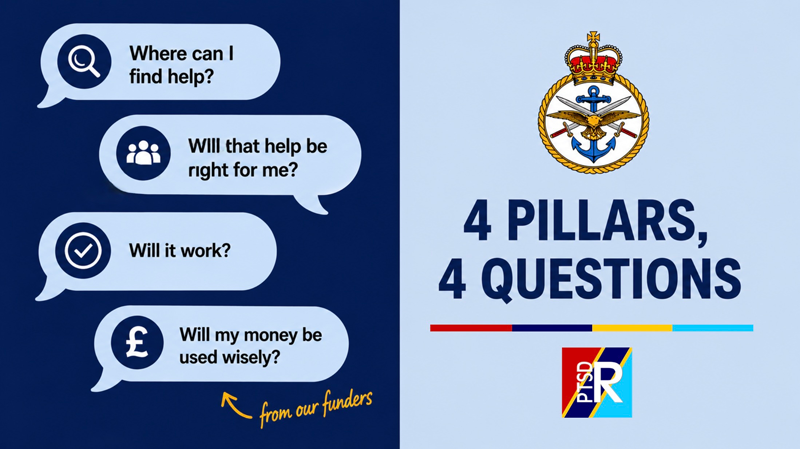
Introduced in 2024, the Four Pillars Framework codifies what sixteen years of frontline delivery taught the charity about what makes treatment work. It is built around four direct questions. Three are asked from the client's perspective:
Can I access the service? (Accessibility) Will I engage with and complete the treatment? (Acceptability) Will it help me recover? (Effectiveness)
The fourth is asked from the funder's perspective:
Is the service delivering the greatest possible impact for every pound invested? (Economic Efficiency)
Each question sits behind a set of concrete metrics, tracked continuously. It is this discipline, applied across every aspect of how the charity operates, that allowed PTSD Resolution to absorb a 63 per cent surge in referrals while maintaining every clinical and operational performance indicator.
What the Evidence Shows
The clinical outcomes are independently verified. Research published in Occupational Medicine (Hall and Greenberg, 2025) confirmed an 82 per cent therapy completion rate, more than fifty percentage points above the NHS Talking Therapies average, with 94 per cent of clients attending two or more sessions. Independent evaluations by King's College London and Nottingham Trent University confirmed a clinical effect size of 1.05, a 66 per cent PTSD recovery rate and a 79 per cent reliable improvement rate across combined anxiety and depression measures. Follow-up data confirms that these gains hold at three months after treatment ends. Of those referred in 2025/26, 57 per cent presented with symptoms consistent with probable complex PTSD.
Each therapy course costs the charity £910 and is delivered free to every client, with 92.5 per cent of all charitable expenditure directed to front-line delivery. For every £100,000 invested, sixty veterans achieve clinical recovery and sixty-six experience a significant and measurable improvement in their condition.
"Being named as a finalist for the Soldiering On Awards is a tribute to our therapists, our partners and every referral organisation that has trusted us with their most vulnerable veterans," said Charles Highett, CEO of PTSD Resolution. "We treated 633 people in 2025/26, our highest ever, without compromising a single clinical outcome or key performance indicator. And behind every one of those clients, there are partners, children and colleagues whose lives are also changed when their loved one recovers."Charles Highett, CEO of PTSD Resolution
The Network That Trusts Them
The clearest measure of where PTSD Resolution stands in the sector is who refers their most complex cases to it. Veterans Outreach Support, The Poppy Factory, OpNova, SSAFA, the Royal British Legion, Bridge 4 Heroes, the Forces Employment Charity and the NHS all rely on the charity to reach people others cannot.
In 2025, that trust was formally recognised on several fronts. PTSD Resolution received the Armed Forces Covenant Employer Recognition Scheme Gold Award, was reaccredited by the Royal College of Psychiatrists to the Quality Network for Veterans Mental Health Services, received the NHS Veterans Aware certificate and became a founding member of the Cobseo Veterans Mental Health Cluster. Together, these place PTSD Resolution at the centre of the national veterans' mental health sector.
What It Means to a Veteran
One serving MP, a former veteran, described calling PTSD Resolution at a point of personal crisis:
"When I called PTSD Resolution, I was in a really bad way and had already developed a suicide plan. They were really quick to act: within 24 hours, they had put me in touch with a local therapist and my treatment began. Without PTSDR, there would certainly be more suicides and I, for one, would not be here now."
Sixteen years of experience distilled into four questions. Four questions built into one system. One system the sector now trusts with its most vulnerable veterans.
"PTSD Resolution saved my life. I cannot thank you enough."Veteran client
About PTSD Resolution
PTSD Resolution (Charity No. 1202649) provides free, confidential, specialist trauma therapy for Forces veterans, reservists and their families throughout the United Kingdom and overseas. Treatment is delivered through a network of 200 accredited Human Givens therapists and also by phone and online. Therapy is completed in an average of seven sessions and costs the charity £910 per programme. The charity was founded in 2009, is accredited by the Royal College of Psychiatrists to the Quality Network for Veterans Mental Health Services and receives no Government funding.
Frequently Asked Questions
What is PTSD Resolution, and who can it help?
PTSD Resolution (Charity No. 1202649) is a national charity providing free, confidential, one-to-one trauma therapy for Forces veterans, reservists and their families.
Founded in 2009, it has supported more than 5,000 people and treats veterans from all branches, conflicts and circumstances, including those dealing with addiction, those based overseas and family members carrying the weight of secondary trauma from living alongside a traumatised veteran. Treatment is delivered through a network of over 200 accredited therapists across the UK and also by phone and online, underpinned by the Four Pillars Framework for Recovery: Accessibility, Acceptability, Effectiveness and Economic Efficiency.
What is the Four Pillars Framework for Recovery, and why does it matter?
Introduced in 2024, the Four Pillars Framework is the system through which PTSD Resolution plans, delivers and measures everything it does. It rests on four questions rooted in the veteran's experience:
Can the veteran reach treatment when they are ready? Will the service keep them engaged? Will the treatment work? And for the charity: is every pound donated delivering the greatest possible impact?
The framework shapes referral pathways, therapist matching, clinical supervision and financial stewardship. It exists because good intentions are not enough. Every part of the service must be measurable, improvable and proven. As the charity's own benchmark puts it: "If we cannot measure it, we cannot improve it. If we cannot prove it, we should not claim it."
How effective is PTSD Resolution's treatment?
The outcomes are independently verified. Research published in Occupational Medicine (Hall and Greenberg, 2025) confirmed an 82 per cent therapy completion rate, more than fifty percentage points above the NHS Talking Therapies average, with 94 per cent of clients attending two or more sessions.
Independent evaluations by King's College London and Nottingham Trent University confirmed a clinical effect size of 1.05. A 66 per cent PTSD recovery rate and a 79 per cent reliable improvement rate across combined anxiety and depression measures were recorded, with follow-up data showing that gains hold at three months after treatment ends. Therapy takes an average of seven sessions.
How is PTSD Resolution funded, and what does a donation actually deliver?
The charity receives no Government funding and relies entirely on donations from individuals, trusts and partner organisations. Each therapy course costs £910, delivered free to every client. The Economic Efficiency pillar ensures 92.5 per cent of all charitable expenditure goes directly to front-line delivery.
For every £100,000 invested, sixty veterans achieve clinical recovery and sixty-six experience a significant, measurable improvement. That efficiency flows from the other three pillars working together: high completion rates, strong outcomes and low-barrier access reduce drop-out, duplication and waste, so that every pound goes as far as possible for as many veterans as possible.