How One Veteran Found His Voice Again
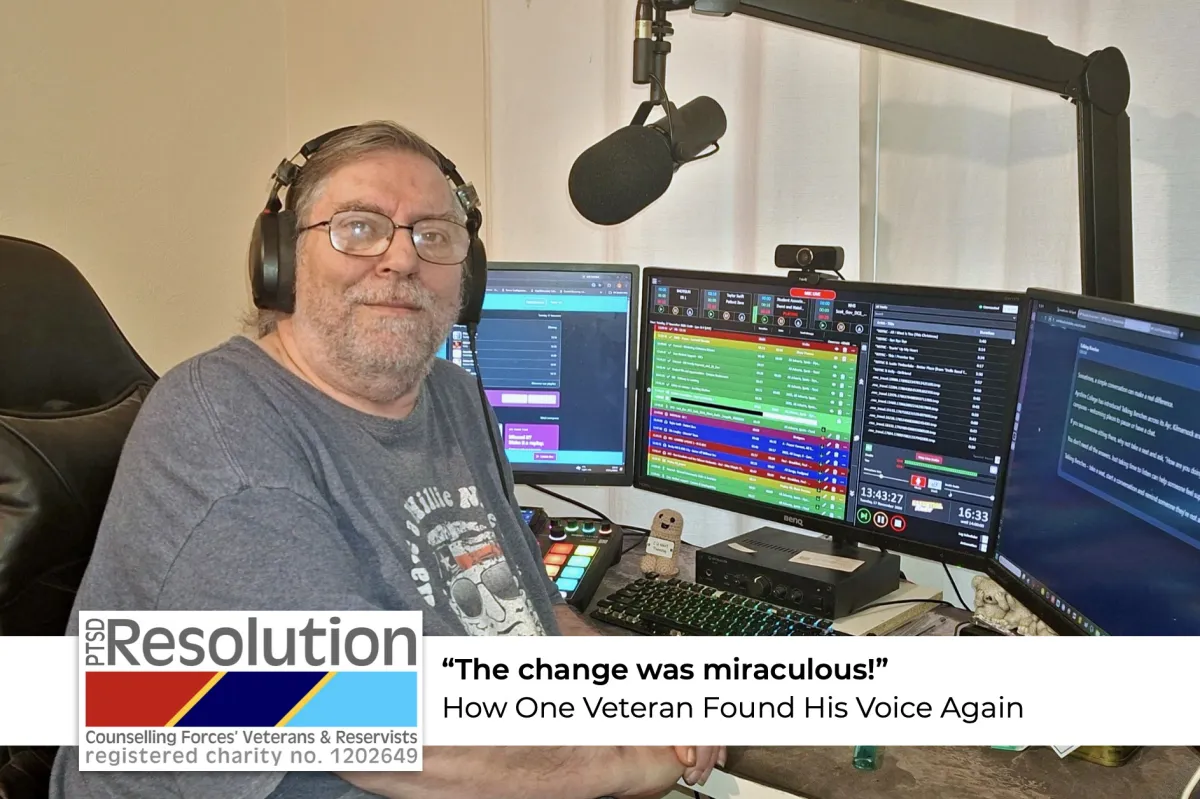
"The change was miraculous!"
How One Veteran Found His Voice Again
Paul Woodland spent decades trying to outrun his past. It took a sudden illness - and a technique he didn't believe would work - to finally give him peace.
Paul has lived on Scotland's west coast for years, though his accent gives him away. He was born in Bournemouth in 1961 and grew up in Kent, where he joined the Army at seventeen and a half.
"It was never going to be my choice to join the army," he says. Circumstances at home pushed him into it. He doesn't regret the nine years that followed. He regrets only the reason he went.
After leaving the forces, he drifted between jobs, as many Veterans do, until he discovered radio in 1990. It became a passion he returned to again and again.
Then, last October, a blood clot in his leg led to a routine weigh-in. The nurse told him he was 145 kilos. He hadn't noticed. By January, without explanation, he was losing weight fast.
"They started to investigate, with blood tests and all the rest of it," he says. "And this just - I don't know why - but this brought back all the memories from my childhood that I thought I had got rid of."
Memories return
The weight loss reopened something else entirely: the death of his partner, Jordan.
Paul had trained as an army medic. When Jordan died, he was the one who found him.
"I couldn't do anything about it,” he says. "I could do nothing, and I felt guilty. I felt that it was my fault. I felt that I'd let him down."
Those thoughts wouldn't leave. Within months, Paul had stopped functioning. He describes the first five months of this year plainly: "I literally couldn't do anything. I got up and sat on the computer. I’d just sit and watch programme after programme."
More than PTSD
Getting help proved its own battle. Paul was passed between services for six months, each with its own waiting list, until the Department for Work and Pensions connected him with a veterans' charity. That charity, in turn, pointed him towards PTSD Resolution.
The name nearly put him off.
"I've never suffered PTSD. I don't know what PTSD is," he says. He never saw active service - he missed the Falklands, missed Northern Ireland. "There's some misinformation out there: if you don't have PTSD, they don't want to know. That is just not true."
PTSD Resolution treats Veterans, Reservists and their family members for a wide range of psychological issues, whether or not they have a formal diagnosis, and whatever the cause. For Paul, it wasn't his time in uniform that had broken him. It was everything that came before and after.
“What have you got to lose?”
Even so, he was doubtful that therapy could help.
"I just didn't see how just talking would ever make a difference," he says. He'd said as much to the friends he'd made in Scotland. One of them, the friend who'd first persuaded him to move north, asked him a question:
"What have you got to lose? Try it. If it doesn't work, it doesn't work. But if it does work, how much better will that be?"
He went into his first session still unconvinced. "Is this really going to work?" he asked his therapist outright. "I can talk to anyone. Why is this going to make any difference?"
A day at the beach
Paul’s therapist suggested trying something before addressing anything painful: a technique called Rewind. She asked him to picture a happy childhood memory, nothing to do with his current troubles.
He chose a day at the beach with his family.
"It brought back so many different memories, just sort of rewinding back," he says. None were unpleasant. All had been sitting unused for years. "They were all always there. But it sort of showed me that the technique does work. It does put things in order. It does put things in perspective."
Only once that groundwork was laid did they turn to the problems that had brought him to PTSD Resolution: "The change was - I shudder to use the word miraculous, but I mean, it was outstanding," he says. Then he stops himself. "Go on then. It was miraculous."
"Just take that step"
Paul is now making decisions he couldn't face a few months ago – and he wants other Veterans to hear one thing above all.
"I don't care how big a sceptic anybody is about counselling. I don't care how withdrawn you are. Just take that step. Speak to someone."
He points out that one of Scotland's largest charities offered him an appointment - after a six-month wait. PTSD Resolution had no waiting list at all.
"Don't be put off by PTSD Resolution having PTSD in the title. It is so much more than that. If you're ex-forces, or a dependant of ex-forces, and you're stuck on a long waiting list, get in touch with them. Do it."
His final piece of advice is the simplest:
"Don't try and cope on your own.
“No man is an island."
-
PTSD Resolution has supported more than 5,000 Veterans, Reservists and family members since 2009, offering free therapy through a UK-wide network of 200 accredited therapists, with no waiting list and no referral required. Eighty-two per cent of clients complete their treatment, well above the equivalent NHS figure, typically within seven sessions.
The charity receives no government funding. It relies entirely on donations to continue offering help of the kind that changed Paul's life - at no cost to the people who need it most.