PTSD Resolution - News article
ID: 090326
PTSD Resolution Treats Record 592 Veterans in 2025 as Demand Surges 29%
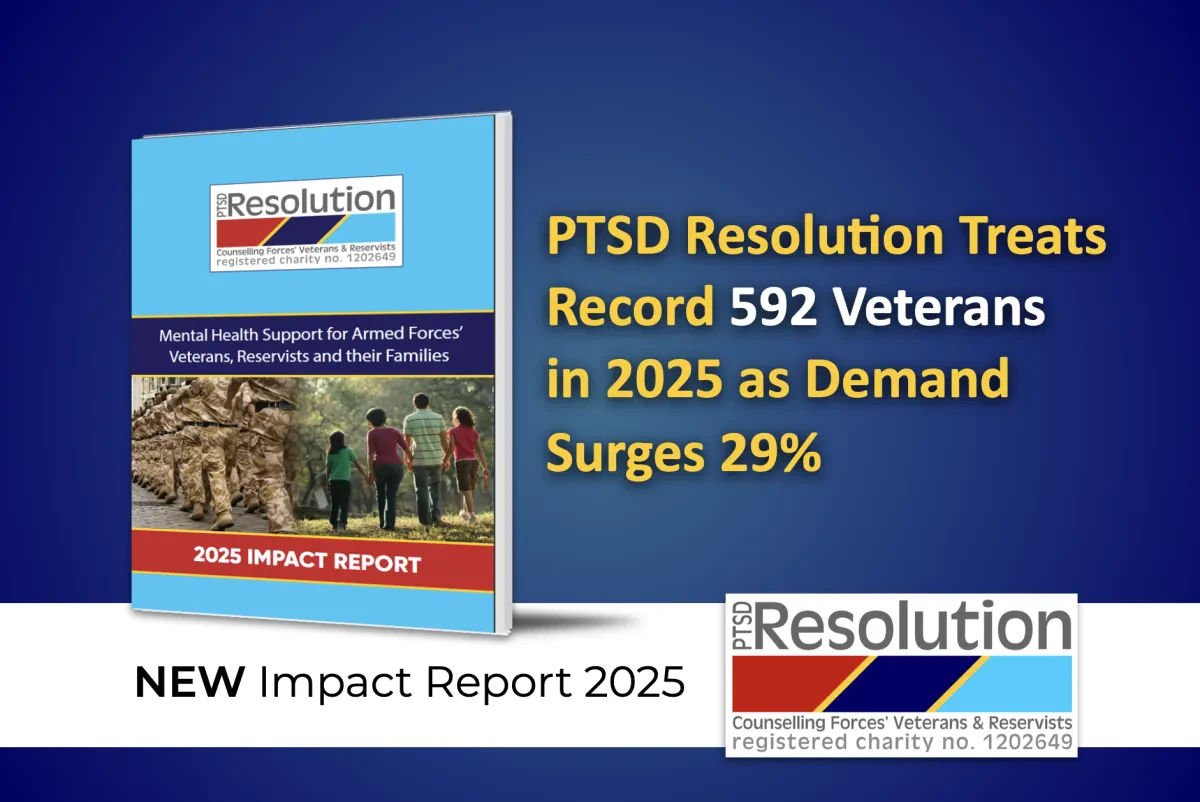
New Impact Report: Two-thirds of veterans treated for PTSD make a full recovery. First therapy appointment within 12 days. And it's completely free.
PTSD Resolution treated a record 592 armed forces veterans, reservists and family members in 2025, the charity has announced in its annual Impact Report, showing demand for its free mental health service up 29% on the previous year.
The results, independently verified and peer-reviewed, show that two-thirds of veterans treated specifically for PTSD made a full clinical recovery. Four in five clients completed their full course of therapy. The average wait from first contact to a first therapy session was just 12 days. The charity has now supported some 4,800 people since it was founded in 2009.
"We know that asking for help is often the hardest part. What we can tell any veteran is this: if you come to us, you will be seen quickly, treated by someone who understands military life, and the evidence strongly suggests you will get better. That is what this report shows, and it is what keeps everyone here going."Colonel Tony Gauvain (Retired), Chairman of PTSD Resolution
A record year for the people who need it most
The charity received 508 new referrals over the year, a 25% increase on 2024, and its helpline handled 3,200 contacts. None of this growth came at the expense of quality. The 82% of clients who completed treatment to a planned ending compares favourably with just 54% for NHS Talking Therapies.
Clinical outcomes that stand up to scrutiny
The charity's results are not self-reported. A peer-reviewed study published in Occupational Medicine (Hall and Greenberg, 2025, Volume 75, Issue 2) examined 211 cases and confirmed that PTSD Resolution's outcomes are equivalent or superior to NHS provision across several key measures. When anxiety and depression scores are combined, 79% of clients achieved reliable improvement, outperforming both England-level IAPT at 67% and the veterans' IAPT cohort at 68%. Crucially, improvements were sustained at the three-month follow-up.
Treatment is delivered in an average of seven sessions, using Human Givens Therapy (HGT). Every session includes outcome measurement, and the clinical team reviews cases in real time to ensure progress is on track.
What it costs and where the money goes
The average cost per therapy course is just £910, met entirely by the charity and delivered free to every client. In the 2024-25 financial year, 92.5% of all expenditure went directly to charitable objectives. A rigorous independent evaluation by Pro Bono Economics found that the charity delivers profound clinical and societal benefits with economic returns well above its costs.
The charity runs with a part-time team of eleven, equivalent to six full-time staff, with no salaried directors and no physical assets. It is, by design, lean.
Reaching further
"We work closely with other armed forces charities to provide an effective national network through our 200 listed HG therapists and additional partnerships, to ensure, as far as we can, that nobody who needs help is missed out."Charles Highett, CEO of PTSD Resolution
More than 70% of clients are now referred through partner organisations, following formal partnerships with Thrive Together, Veterans Outreach Support, The Poppy Factory, Bridge for Heroes, and Change Grow Live, among others, covering all four nations. The charity has also extended its work into the Scottish prison estate and has supported veterans in more than 20 countries through its overseas programme.
The Trauma Awareness Training and Education (TATE) programme was delivered to over 80 caseworkers, referral partners and charity staff in 2025. The workshop is available as a half-day or full-day course, online or in person, as an open public course and also in-house. It received a 5/5 rating from delegates throughout the year.
"TATE's proven methodology and consistent results make it an essential tool for any organisation committed to mental health awareness and support."Charles Highett
Awards and recognition
In September 2025, PTSD Resolution received the Ministry of Defence Employer Recognition Scheme Gold Award, the highest honour available to organisations supporting the Armed Forces community, placing it among just 16 organisations across the South East to achieve Gold status that year. In January 2026, the charity welcomed Lord Jock Stirrup as its new President.
"This award recognises the dedication of our entire network who work tirelessly to ensure no veteran faces mental health challenges alone."Charles Highett
Notes to Editors
PTSD Resolution (Charity No. 1202649) provides free, prompt, confidential mental health treatment to armed forces veterans, reservists and their families. Treatment is delivered by a nationwide network of over 200 qualified Human Givens therapists, in person, online or by telephone. The charity is accredited by the Royal College of Psychiatrists to the Quality Network for Veterans Mental Health Services. Since its founding in 2009, it has supported some 4,800 clients.
The full 2025 Impact Report is available at www.ptsdresolution.org
Media enquiries: contact@ptsdresolution.org | Helpline: 0300 302 0551
Frequently asked questions
About the charity
What is PTSD Resolution and who does it help?
PTSD Resolution is a UK charity that provides free mental health treatment to armed forces veterans, reservists and their families, including partners, spouses and children. It was founded in 2009 and has now supported some 4,800 people. The service is free, confidential and available without a GP referral or formal diagnosis.
How many people did PTSD Resolution treat in 2025?
592 clients were treated in 2025, up 29% on the previous year. The charity received 508 new referrals and its helpline handled 3,200 contacts over the course of the year.
Getting help
How quickly will I be seen?
The average wait from registering with the charity to a first therapy session is 12 days. That benchmark was maintained throughout 2025, even as demand hit record levels.
Do I need a GP referral or a formal diagnosis?
No. You can contact the charity directly. There is no requirement for a referral, a diagnosis or any other paperwork. Call 0300 302 0551 or visit www.ptsdresolution.org.
Is there any cost to me?
None. Treatment is completely free to every client. The full cost, averaging £910 per therapy course, is met by the charity.
Treatment and outcomes
Does the treatment actually work?
The evidence is strong and independently verified. Of veterans treated specifically for PTSD, 66% made a full clinical recovery. When looking at anxiety and depression together, 79% of clients achieved reliable improvement, outperforming both England-level NHS Talking Therapies at 67% and the veterans' IAPT cohort at 68%. These results were confirmed in a peer-reviewed study published in Occupational Medicine in 2025 (Hall and Greenberg, Volume 75, Issue 2).
Will I have to keep going to therapy for months?
No. Treatment averages seven sessions. The goal is to relieve symptoms and help clients get back to normal life, without creating any dependency on ongoing support. The client and therapist agree together when no further sessions are needed.
What happens to people who start treatment, do many drop out?
Very few. In 2025, 82% of clients completed therapy to a planned ending, compared to around 54% for NHS Talking Therapies. Only 6% attended a single session. Once people engage, they tend to see it through.
Do the results last?
Follow-up data collected three months after treatment shows that clinical improvements were largely sustained. Scores remained below clinical thresholds and were significantly lower than they were at the point of entry.
What kind of therapy is it?
Treatment is delivered one-to-one by qualified Human Givens therapists, either in person locally or online by phone or video. Human Givens Therapy is an approach that does not require clients to relive traumatic events in detail, which many veterans find more manageable than traditional trauma therapies.
Who else can be helped
Can family members get help too?
Yes. Partners, spouses and children can all receive treatment. In 2025, 12% of all clients were family members. The charity recognises that living with a traumatised veteran can cause significant mental health difficulties in its own right.
What if I have a drink or drug problem alongside my PTSD?
PTSD Resolution will still treat you. It is one of the only organisations that works with veterans experiencing co-occurring addiction or substance misuse issues. In 2025, the charity launched a collaborative research programme with Change Grow Live to develop an integrated treatment model combining mental health therapy with substance recovery support.
What if I live overseas or am in prison?
Both groups can be helped. The overseas programme has now supported veterans in more than 20 countries through online and telephone therapy. The charity also works with veterans in custody in Scotland and Wales.
The charity's approach
How does PTSD Resolution make sure its results are genuine?
Outcome measures are recorded at every therapy session using validated clinical tools, including the PCL-5, PHQ-9 and GAD-7 scales. Results are tracked in real time through the Pragmatic Tracker system, reviewed regularly by the clinical team and published openly. The charity's guiding principle is straightforward: "If we cannot measure it, we cannot improve it. If we cannot prove it, we should not claim it." We collect evidence 'on the front line' of therapy: this is known as 'practice-based evidence'. It gives us a real-world picture of what is going on: no ivory towers, just the raw facts on the ground.
How much of the money raised actually reaches veterans?
In the 2024-25 financial year, 92.5% of all expenditure went directly to charitable objectives. The charity runs with a part-time team of eleven, has no salaried directors and owns no physical assets. An independent evaluation by Pro Bono Economics confirmed that it delivers economic returns well above its costs.